Choose Application Behavior and Ownership
Choose TypeScript or Python for a Backend Service: Workload, Contracts, and Ownership
Choose TypeScript or Python for a backend by examining its workload, API boundaries, validation needs, and operational ownership.
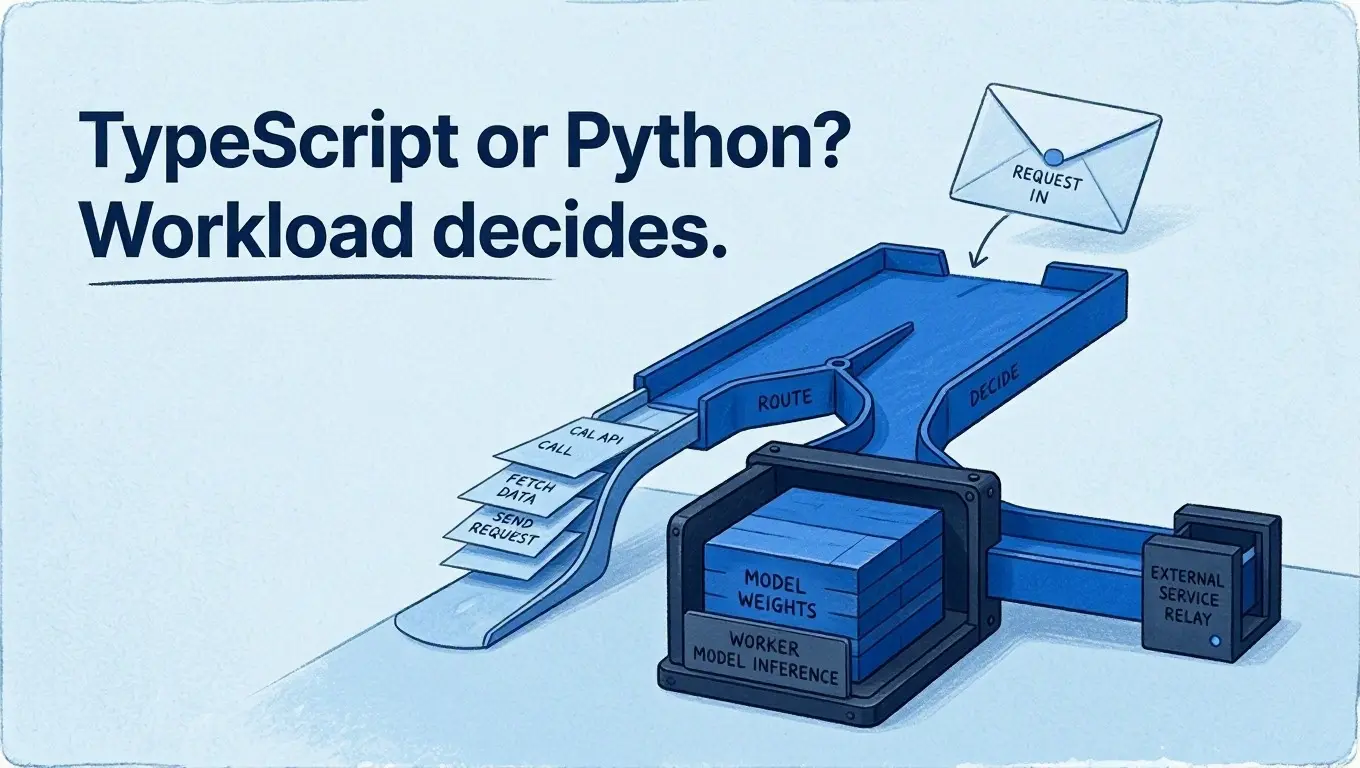
If a backend’s defining job depends on PyTorch, Pandas, or NumPy, start the language decision with Python. If its defining job is handling product requests and coordinating other services in an existing TypeScript stack, TypeScript with Node.js is a reasonable starting point. An API that calls an AI feature does not necessarily need to run the data or inference workload itself.
That distinction is more useful than asking whether TypeScript or Python is better for backends. First identify what the service must do, which dependencies make that work possible, and who will maintain it after launch.
Find the work that determines the language
Consider a proposed endpoint that authenticates a request, collects account data, calls an inference service, and returns a result. Most of that description is product API work; the inference call is a dependency. Now change the proposal: the service must prepare datasets, run model evaluation, and perform inference using Python libraries. Those dependencies are no longer incidental. The Python ML and data ecosystem is a substantial reason to put that work in Python.
Write down the operations the service will own rather than classifying it as simply “an AI backend.” Does it chiefly handle requests and orchestrate calls? Does it chiefly process data or execute model code? If both are important, ask whether they have separate deployment and ownership needs. The answer may be one service or two; an AI feature alone does not settle it.
A team already maintaining a TypeScript frontend and Node.js services can also consider the integration benefit. Types and validation logic can be shared across a TypeScript stack, as discussed in this comparison of backend options. That benefit applies only to contracts the team actually maintains and uses. It does not make a network response trustworthy just because the client and server refer to the same interface.
Decide where contracts become checked values
A language choice does not remove the need to validate incoming data. TypeScript checks code before execution, but its types are erased; Python annotations are not runtime argument checks either. JSON arriving from a client or another service therefore needs a runtime check in either language. This explanation of the two typing models names Zod and Pydantic as examples of schema-based validators.
Map the entry points before choosing where schemas and contract tests belong:
- Client requests: Check the body before passing its fields to application logic.
- Third-party responses and webhooks: Check data when it enters the service, even when its provider publishes a schema.
- A separate internal service: Agree on its request and response contract, and check received values at the boundary. A REST, gRPC, or message-based interface gives independently owned services an explicit point of agreement.
- Code deeper inside the service: Decide what its functions can assume. An HTTP validator does not automatically protect paths that never use that validated model.
These checks address different failures. A TypeScript type can help maintainers keep calls consistent with a declared shape; a runtime validator can reject a value that does not have that shape when it arrives. A Python API model and a mirrored client-side Zod schema illustrate checks on both sides, but mirroring them creates a maintenance obligation: decide how a contract change reaches both implementations and how tests detect disagreement.
Add a second runtime only when the boundary earns it
A split can make sense when product/API work and data or ML work have different centers of gravity. One possible arrangement gives TypeScript ownership of authentication and request orchestration, Python ownership of data preparation and inference, and both teams an explicit service contract. That is an architectural choice, not a requirement for every backend that mentions AI.
The cost is concrete: two languages bring separate deployment pipelines, dependency management, and monitoring arrangements, plus a need for engineers who can maintain both sides or a clear ownership boundary. The hybrid-stack discussion calls out those operational and team costs. A service boundary also makes contract changes and failures across that boundary part of ordinary maintenance. If the proposed Python component has no independent workload, dependencies, or owner, keeping orchestration in an existing service may be simpler. If it owns substantial Python-dependent work, a separate service can make that dependency and its ownership explicit.
Treat speed claims as questions to test
Do not turn “is TypeScript faster than Python?” into a capacity plan. One Fastify/FastAPI comparison says community synthetic JSON-serialization tests generally put Fastify ahead, but its author did not rerun them and explicitly calls the result directional. That says little about an endpoint waiting on a database, an external API, or model inference. It is not a measured capacity estimate for either proposed service.
Instead, identify the likely limiting operation, choose plausible frameworks and deployment conditions, and measure the representative request path when performance could change the decision. Keep runtime, framework, workload, and resource use in the result; a language name alone is not a benchmark configuration. Make the initial choice from the work and ownership you can identify now, then use measurements to challenge it where throughput or latency actually matters.